
St. John Address History Sources
The best source depends on the date and on whether the question concerns the owner or the household. Lake County has no verified public series devoted only to St. John previous residents. Build the timeline from county land records, regional directories, federal census schedules, town files, and historical indexes. Some runs are exact; others remain unknown and should be treated as gaps.
| Source | Years It Covers | Where Held | What It Shows |
|---|---|---|---|
| Recorded land instruments | More than 200 years held; web cutoff not stated | Lake County Recorder | Owners, deeds, plats, easements, liens, book/page links |
| Haines Criss Cross | 1982 to present per local list | Crown Point library resources | Address-to-occupant clues; issue coverage must be checked |
| County-wide Polk | 2012, 2015, 2020 | Indiana State Library | Named county directory entries; verify St. John inclusion |
| Federal census microfilm | 1840 to 1880 and 1900 to 1930 locally listed | Crown Point resources / federal records | Household members and relationships in census context |
| Lake County indexes | Land 1837 to 1857; plats 1869 and 1891 | Indiana State Library guide | Early owner, land, and subdivision leads |
| Town permit files | Online start not verified | St. John Building and Planning | Plans, contacts, inspections, and building-change dates |
For a recent house, begin with the assessor and current deed. For a late twentieth-century household, test Haines issues around known years. Earlier work may shift to census, plat, land, newspaper, cemetery, and probate sources.
Fix the St. John Address
Before looking for past residents, separate the physical, mailing, and historical forms of the address. The assessor's situs address is where the parcel lies. Its mailing address is where tax correspondence goes and may be elsewhere. Save the parcel number, legal description, subdivision or plat reference, township, and incorporated-municipality field. Those details survive formatting changes better than a street label alone.
The Lake County assessor parcel detail demonstrates the property, owner, transfer, and assessment sections available on a current card.
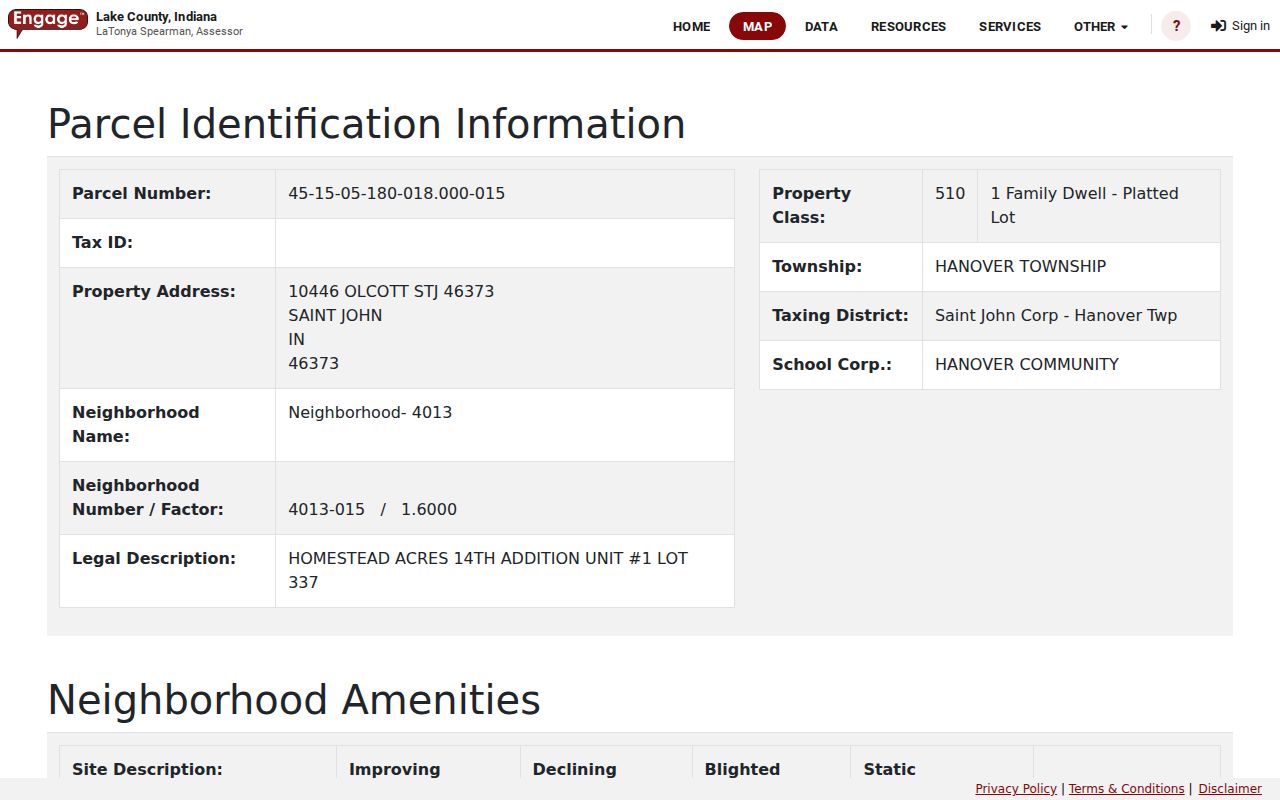
The sample is a model for what to record, not a claim about that parcel's past residents. Search St. John, Saint John, St John, SAINTJOHN, and ZIP 46373 variants when an index misses the address.
Trace Lake County Past Owners
A deed chain runs backward through people who received and conveyed the same land. Start with today's deeded owner on the assessor card. Use the legal description as the control, because a person's name can recur and an address can be reformatted. The recorder preserves deeds as well as plats, mortgages, easements, liens, and releases that may explain gaps or changes.
- Copy the current property ID, owner, legal description, and any transfer date from the assessor.
- Find that owner's purchase instrument in the Lake County Recorder search. Record the instrument type, date, parties, and book/page or document reference.
- Treat the seller on that deed as the next search key. Search that person as a grantee to locate the earlier purchase.
- Compare the legal description at every link. Stop when it changes in a way that suggests a split, combination, or different parcel.
- When the online trail ends, contact or visit the Recorder for older index books and document copies. The precise web cutoff was not published.
- Grantor
- The party who conveys an interest in land.
- Grantee
- The party who receives the recorded interest.
- Chain of title
- The sequence of recorded transfers for the same land.
- Legal description
- The land description in a deed or plat, more stable than a postal address.
St. John Recorder Access Routes
The Recorder's public Search and Advanced Search controls lead to an account login. Registration asks for username, password, email, first and last name, and phone. That gate is an access step, not proof that no document exists. The office says its holdings extend more than 200 years, while the exact public-web index start remains unverified.
The Recorder records search shows the login route encountered by a St. John previous residents researcher.
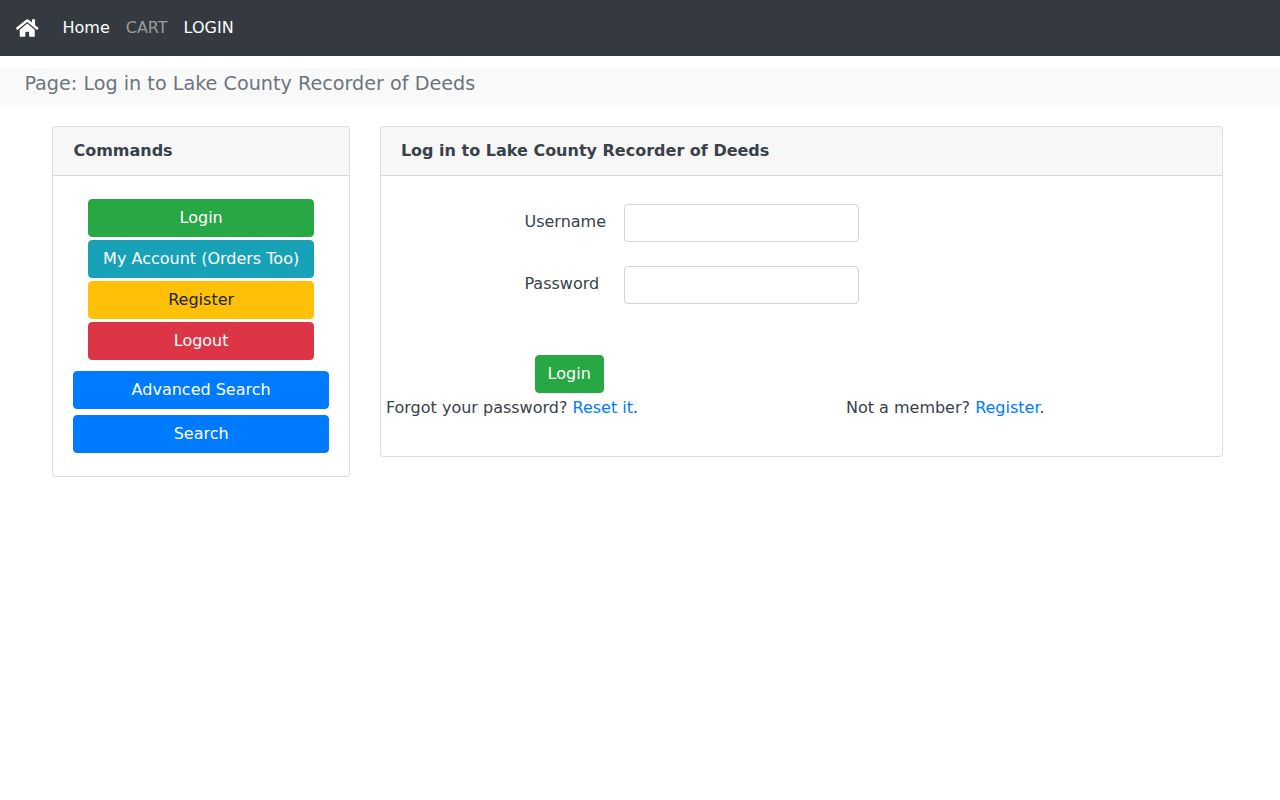
Create an account only if appropriate, or use the office fallback. The Recorder lists 219-755-3730 and weekday hours of 8:30 a.m. to 4:30 p.m. Its purchase page states $1 per page plus a $3 administrative fee per order.
The Recorder search and purchase page explains the one-line and individual-field search methods.
Save the actual image when available. An index entry points to an instrument; the recorded page supplies the parties, legal text, signatures, acknowledgments, and recorder mark.
St. John Plats Bridge Time
A subdivision name and plat reference can connect a current address to a land record that never used the current street form. An official county sample concerning St. John Township cites an address on West 93rd Avenue together with Stevenson's First Addition, Plat Book 42, page 40. It is not offered as a house-history result. It shows the method: retain the plat, lot, and legal description alongside the street address.
Development names can also become search terms. County and town sources use Gates of St John, Bungalows-Gates, The Preserve, Greystone, Weston Ridge, Castle Rock, St. John Don Estates, Dancing Waters, Park West, and other labels. A name may outlast a builder, association, or postal label. Confirm it in the recorded plat before attaching it to previous residents.
Land-record bridge. If an old deed lacks the modern address, match the plat, lot, section-township-range, and parcel geometry before continuing backward.
St. John Households Between Deeds
Deeds trace ownership, not necessarily who lived in the house. Haines Criss Cross Northwest Indiana issues from 1982 forward can supply address-to-name clues, subject to physical issue coverage. County-wide Polk issues listed for 2012, 2015, and 2020 may help, but St. John inclusion must be verified in each volume. The detailed collection runs belong on the St. John directory book page.
- Choose a directory issue close to a known deed, permit, or family date.
- Search the exact address in the reverse section, then check each name in the regular alphabetical section.
- Compare several issues. One line can be stale, omitted, or printed under initials or a spouse's name.
- Bridge to an available census year and verify the township, enumeration area, street, and household sequence.
- Use a newspaper or obituary to test a move, death, former surname, or family relationship.
The local microfilm list covers 1840 through 1880 and 1900 through 1930 for Lake and Porter counties. The missing 1890 federal schedules are a national loss, so use land, directories, newspapers, tax material, and vital indexes to span that gap.
Library Trails for Previous Residents
The Indiana State Library Lake County guide maps early land purchases, plat books, marriages, naturalizations, WPA birth and death indexes, cemeteries, military records, and obituaries. It supplies a dated route into the era before modern parcel systems without claiming each original item is online.
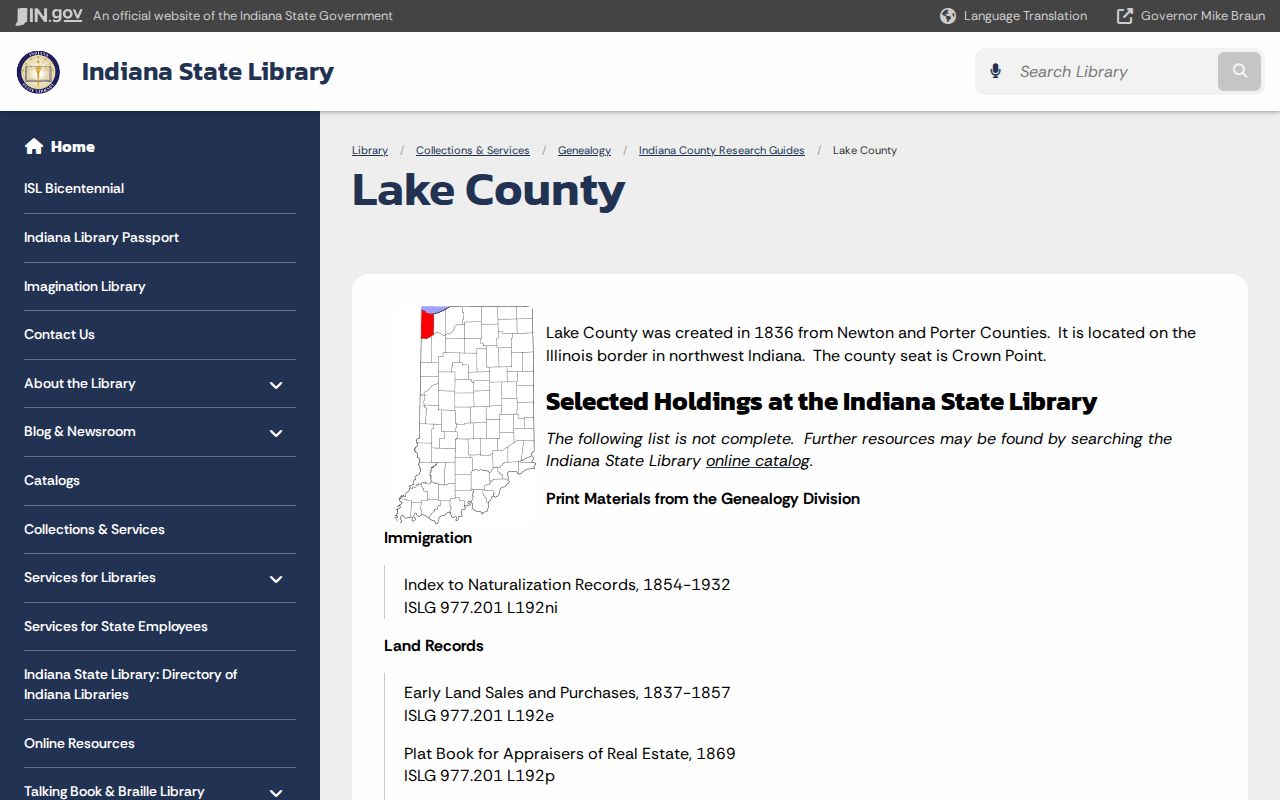
The guide is especially useful after the deed chain yields a surname or plat. Follow its citation to the holding library or archive, then inspect the source rather than treating an index transcription as the final record.
Lake County Public Library's obituary index covers the Post-Tribune from 1921 to current and the Lake County Register and Star from 1857 to 1938. Search fields include a full, partial, or maiden name, date, city, and age. Ask for the clipping because an “of St. John” line may describe community association rather than a precise address.
Lake County Books Go Digital
Lake County preservation does not follow one clean online cutover. The Recorder maintains a book-scanning project and reports that e-recording began in March 2021. Current digital access therefore sits on top of older books and indexes, not in place of them. A missing web hit may call for the counter, a request, or an archival source.
The Lake County Recorder book-scanning project records that preservation work.
This layered history matters for a backward search. Do not place an invented year on the online deed index, and do not assume an absent image means the underlying record was destroyed.
Complete a St. John Timeline
Town permit records may date an addition, deck, fence, shed, inspection, or final survey. St. John Building and Planning uses Cloudpermit and accepts email or hard-copy routes, but no open address index was confirmed. Ask for an existing file with a tight address and date range through the town's records process when the online route is incomplete.
At the end of a person's trail, combine obituary, cemetery, probate, and death-index sources. The Lake County Clerk keeps probate and wills or trust matters in its court role. Historical death clues may appear in Indiana Legacy or library indexes, while certified death records remain subject to state eligibility rules. A probate file can link an owner to heirs, but it still needs the property description or deed to connect it to the house.
Note: Permit applicants and estate parties are dated record contacts; neither source by itself proves that a person occupied the St. John property.
Limits on St. John Past Residents
A deed proves a recorded land interest, not a full household. A reverse directory can lag behind a move. Census schedules can omit, misspell, or group people in ways that demand page-level review. Assessor transfer history may be incomplete, and one inspected parcel card displayed no sales record even though that single observation cannot prove the parcel never sold.
Protected addresses may also be withheld. Indiana's Address Confidentiality Program and covered-person rules can remove names or address details from open systems. Respect a redaction and use previous-resident research for family history, estate work, house history, and lawful personal curiosity.
Lawful use. Never use a St. John address timeline to track, harass, intimidate, or harm a living person. Verify sensitive conclusions with the proper custodian.