
St. John Resident Lookup Sources
A name can appear in several public systems without proving that the records belong to one person. A St. John resident lookup works best when each source answers a narrow question. The Lake County tax roll can connect an owner to a parcel. Indiana MyCase can show a public court case tied to that name. Indiana Voters verifies registration through an individual inquiry, while vital indexes and obituaries can support a family-history search. Business and license files confirm public affiliations, not a home address. Start with the record closest to the fact being checked, then compare at least one independent detail.
| Record | What It Confirms | Where to Search | Access |
|---|---|---|---|
| Property roll | Owner, mailing and situs addresses, parcel, transfers | Lake XSoft | Free; covered-person redactions apply |
| Voter registration | Individual registration and polling details | Indiana Voters | Individual verification; bulk access is regulated |
| Court index | Case number, court, parties, dates, status | Indiana MyCase | Free public index; Clerk supplies official copies |
| Vital and obituary records | Events, relatives, former names, dates | IDOH and library indexes | Indexes vary; certificates are restricted |
| Licenses and filings | Credential or business affiliation and status | Indiana PLA and Secretary of State | Free public search; address may not be residential |
If the known fact is an address, inspect the assessor result first. For a case reference, go to MyCase and preserve the court and case number. Family-history work belongs in the Lake County Public Library obituary index, Indiana Legacy, probate files, and eligible vital-record channels. A license or entity search is useful only when a profession or business is already relevant. None of these sources is a complete roll of current St. John residents.
Search St. John Names in MyCase
The statewide MyCase name search covers Lake Circuit and Superior Courts. Its Name tab offers first, middle, and last-name fields, sounds-like controls, a court selector, open or closed status, and filing-date limits. Search the narrow spelling first. Add Lake County, a middle name, a date range, or a known case type before trying sounds-like matching. More than 1,000 hits is too broad to identify a St. John resident with care.
A useful result can display a case number, court division, case type, filing date, party roles, status, chronological entries, public documents, and a disposition. Not every field or document appears in every case. Adoption matters are excluded, and sealed, expunged, juvenile, protection-order, older, or non-imaged material may be limited. MyCase itself is not the official record. Ask the Lake County Clerk for a certified or complete file when the distinction matters.
| Result field | Why to retain it |
|---|---|
| Case number and court | Separates one proceeding from a same-name match |
| Party name and role | Shows how the person is connected to the case |
| Filed date and status | Places the entry in time and shows open or closed |
| Chronological entry | Lists public events, codes, and document availability |
| Disposition or final order | Shows an outcome when the public record includes one |
Confirm the St. John Name
St. John has several index forms: St. John, Saint John, St John, and the assessor's compact SAINTJOHN. People also appear under initials, former surnames, compound names, or newspaper spelling errors. A name alone is weak proof. Pair it with two independent anchors such as a middle initial, parcel number, dated address, lawful age detail, relative, business affiliation, court division, or obituary date.
Describe the finding with the source's own limits. An assessor hit is a tax-roll owner. A court hit is a party with that name. A license hit is a credential holder, and a voter match is a registration result. If two sources conflict, contact the custodian that owns the record instead of blending the entries into one identity.
Note: A tax mailing address or homestead deduction does not, by itself, prove that the named owner now lives on the parcel.
Verify a St. John Resident
Use a short chain for a current property-related check. The aim is not to gather every mention of a name. It is to test whether the name, place, and date align across records that were made for different reasons. Keep the physical address, tax mailing address, and legal parcel identity separate throughout the resident lookup.
- Search the name or known address in Lake XSoft. Save the owner name, situs address, mailing address, parcel number, and legal description.
- Check MyCase with the exact name and Lake court filter. Compare dates and case context without assuming a name match is the same person.
- Use a relevant vital index, obituary, business filing, or license record as the second anchor. Do not use a restricted certificate as an open directory.
- Request the official image or certified copy from the Assessor, Clerk, Recorder, IDOH, or library when an index entry is not enough.
- Docket
- The court's running case record, including filed events, orders, and status.
- Index vs image
- An index points to a record through names and dates. An image shows the filed document itself.
- Certified copy
- A custodian-issued copy marked as a true copy of the official record.
St. John Family Record Routes
Birth, death, marriage, and divorce records follow different paths. The Indiana Department of Health holds state birth records from October 1907 and death records from 1900. Lake County's local health department offers a county walk-in channel for eligible events. Birth and death certificates require identification and a qualified or direct-interest relationship. They are not open lists for a resident lookup.
The Lake County Clerk handles marriage-license copies and court divorce files. Its marriage search route is described as covering 1993 forward, while older pointers may appear in Indiana Legacy and State Library county indexes. For an adopted person or birth parent, the lawful path is IDOH's Adoption Matching Registry and confidential-intermediary process. Sealed records do not become public merely because the request is for family history.
Indiana's forms provide mail and in-person routes when an online index is absent. Confirm current eligibility, identification, price, and processing time before sending a request.
Trace St. John Heirs Carefully
The Lake County Public Library genealogy service indexes the Post-Tribune from 1921 forward and the Lake County Register and Star from 1857 through 1938. Search fields can include a partial or maiden name, date, city, and age. That makes an obituary pointer more useful than a bare surname, especially when a resident lookup must distinguish relatives with similar names.
For an estate question, move from the obituary to a probate entry, will or estate file, and then to a recorded deed or affidavit when property passed. MyCase may provide the public case pointer, while the Clerk controls the probate file and copy rules. Keep the request limited to the needed record. A relative named in an obituary or estate file is not automatically a current St. John resident.
Note: A library index identifies the newspaper source; it does not replace the article image, probate file, or certified death record.
Confirm St. John Public Affiliations
The Indiana Professional Licensing Agency verifies a public credential by profession, name, license type, status, city, county, ZIP, business name, or license number. Results can show the license number, issue and expiration dates, status, and a public address. The Indiana business search adds entity status, registered agent, governing people, filings, and business-address clues.
These are affiliation checks. A registered agent can be a service provider, and a license address can be an office or former contact point. Lake County Recorder records may add assumed business names, but its public search leads through a login or registration flow. If the online trail fails, ask the Recorder about an index search or copy rather than treating the missing web hit as proof that no filing exists.
The Indiana Unclaimed search can also connect a name or business to state-held property. The screenshot below shows the official starting point, not proof of ownership or identity.
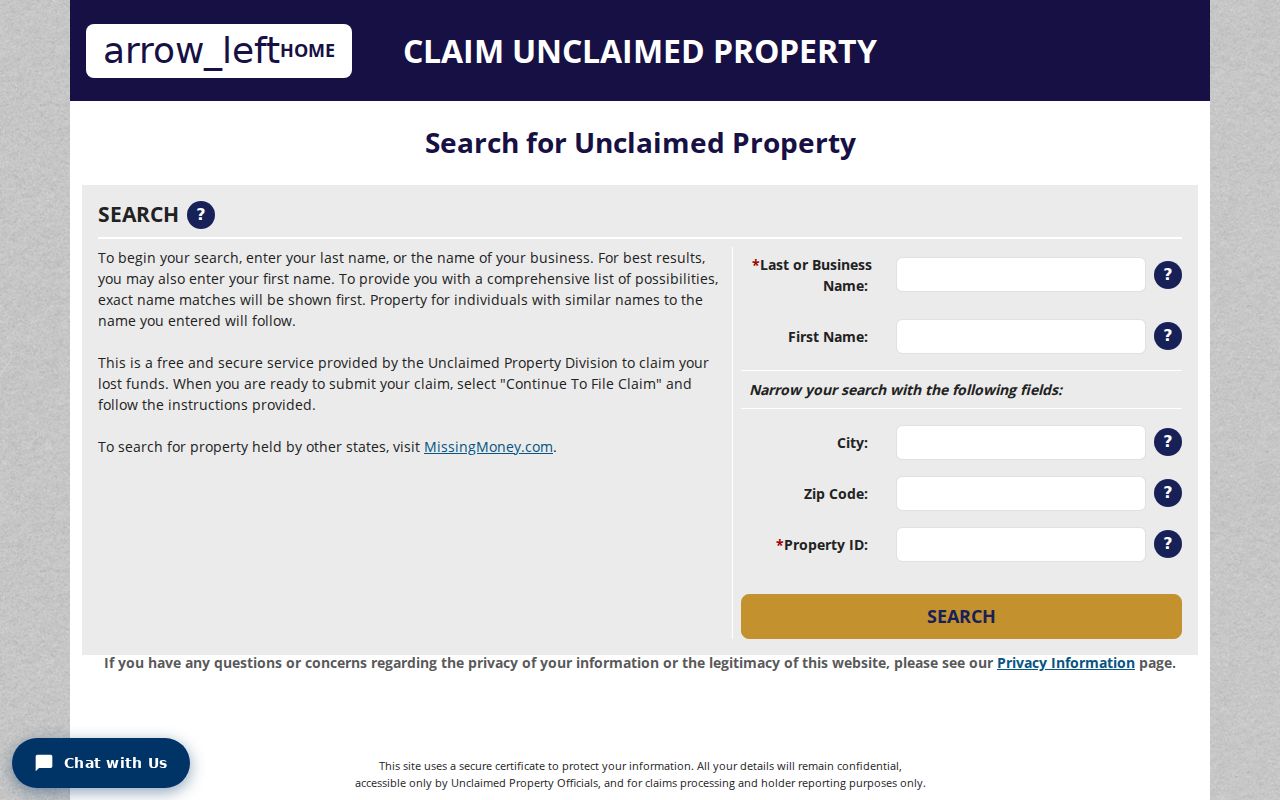
A claimant still must complete the state's verification process before property is released.
Request Missing St. John Records
When no public index answers the question, request the existing record from its keeper. The St. John Clerk-Treasurer records page provides the town route, and its form allows email delivery or office pickup. It asks for a specific description of existing records. Indiana's Access to Public Records Act, IC 5-14-3-1 and following, does not require an agency to create a new list or analysis.
Send court and probate requests to the Lake County Clerk, property corrections to the Assessor, recorded-document questions to the Recorder, and certificate requests to IDOH or the local registrar. An in-person or oral APRA request should receive a response within 24 hours. A written request by mail, email, or fax should receive one within seven calendar days. A response may acknowledge the request and set a reasonable production period; it is not a promise that all records arrive by that deadline.
Indiana Safety Record Boundaries
Indiana State Police offers an official name-based Limited Criminal History service. It returns state information based on a supplied name and birth date, with optional identifying fields. Outcomes can be on file, inconclusive, or no records found. County participation, same-name matches, sealed matters, and expungements affect what appears. It is not the same record as a court docket.
The state service page shown below explains the official route. Use its current instructions and read the result in light of those limits.
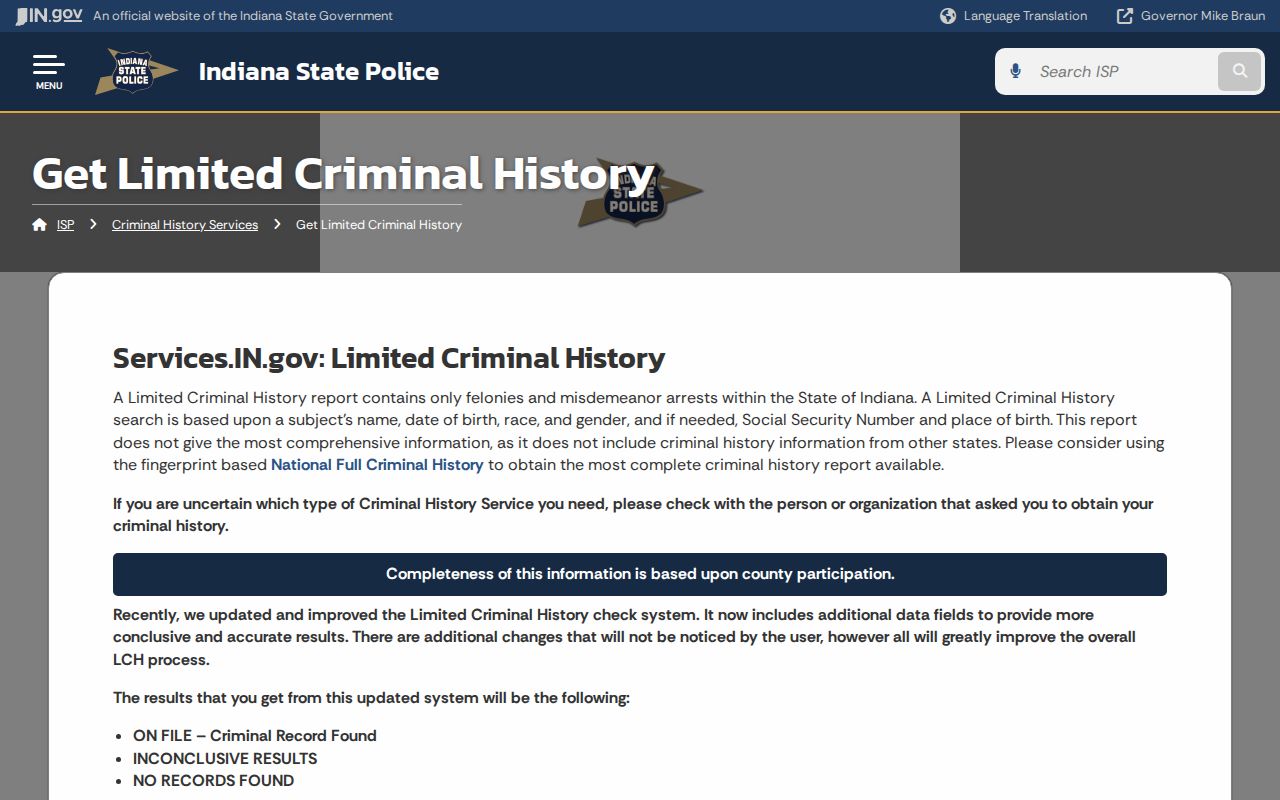
A public-safety search should stay tied to a lawful personal need. Do not republish an allegation or assume that an old entry identifies the person being sought.
St. John Resident Lookup Limits
Some missing details are protected on purpose. Indiana's Address Confidentiality Program can substitute an address and protect voter name, address, phone, and identifying information. Covered-person rules under IC 36-1-8.5 can restrict assessor names and addresses. Birth and death certificates have direct-interest rules, and sealed, expunged, juvenile, adoption, and protected court matters are not normal public results. Utility accounts and motor-vehicle addresses are also outside an ordinary St. John resident lookup.
Correct an error at its source: the Assessor for tax-roll facts, Clerk for court files, county voter registration office for voter data, IDOH for a certificate, Recorder for an instrument, or the library and publisher for an index error. Stop when the official trail ends. A compiled commercial search can be stale, merge people, and expose old addresses; it does not override a sealed record or confidentiality protection.
Lawful use. Use a St. John resident lookup only for lawful personal research. Never use a record to stalk, harass, threaten, or intimidate anyone.